




23 Sep 2020
Press release: Asylum and Migration Pact
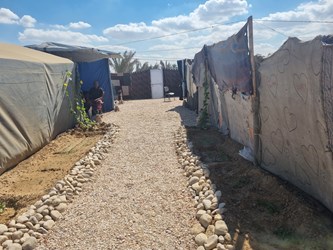
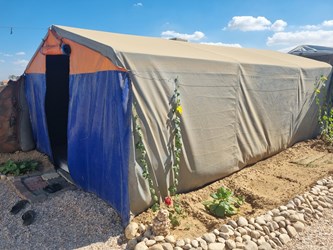
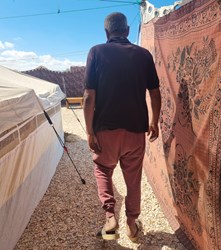
Abu Mohammad is a carpenter from Rafah. Before the war, he lived with his wife and five children in a home he spent decades building, stone by stone. Today, he lives in a tent in a displacement site in Al-Mawasi (Rafah), side by side with his brother who was displaced from Gaza City. Their two tents sit only meters apart, and the two families support each other like one household; sharing food, tools, labour and hope. His hands once crafted furniture and carved wood; now they hold fabric and rope against winter winds, plant flowers beside a tent wall, and lay seashells under bare feet to keep out the mud. Where a home once stood, a shelter stands, held up by work, memory, and will.
Abu Mohammad speaks with a voice that carries both strength and sadness: “I’ve been running from one place to another like a tree without roots. Every time I try to rest, the ground moves again under me,” says Jamal after being displaced six times.
When the first ceasefire came, Abu Mohammad returned to Rafah hoping to find home again, but what he found was ruin. “When I saw Rafah, I couldn’t recognize her. The streets I grew up in were buried in dust. The smell of gunpowder and death was everywhere. My home, my dreams, my life .. all buried under the stones I built with my own hands.”
He had spent decades saving and working to build that house. “I built it stone by stone. Every corner of it had a memory. But this is life. At least we are alive.”
During the short ceasefire, Abu Mohammad lived in a small tent next to the ruins of his home. He refused to leave, clinging to hope that peace might last. “Everyone came to see their destroyed houses and left. But I stayed. I wanted to feel near my home.. even if I was living under a tent.” When the ceasefire collapsed, chaos returned. “People were running in the streets like madness. Shells falling, bullets everywhere. I wanted to stay near my house, but I had to run to save my family.”
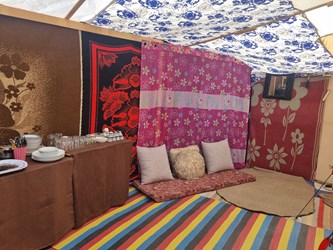
He moved to Mawasi Khan Younis for several months. As a carpenter, he used his skills to build a simple but beautiful tent for his family. “I tried to make it feel like home. I used what I found... wood, cloth, and hope.”
Yet life there became impossible, crowded, unsafe, and full of fear. So he returned to Rafah and settled in Mawasi, near his brother. “Here I feel peace, even with the bombing. There’s magic in the air of Rafah. It hurts me, but it’s still home.”
Basic Needs and Daily Life
Abu Mohammad and his brother now live like one family, sharing food, tools, and hope. Their two tents stand side by side.. a small circle of life in a sea of displacement.
“We help each other. When my brother has nothing to cook, I share what I have. When I feel tired, he encourages me. That’s how we survive together.”
He built a solid floor of seashells to keep the mud away, planted flowers and small trees, and made a kitchen with his own hands. Next to the tent, he created a small play area for his children and a wooden gate to mark their space.
“I miss my house. The place where my children grew up. I feel the pain of losing it every day. But I will rebuild. Even if it starts with a flower beside a tent.”
Their access to food and water remains limited. Abu Mohammad says his main goal now is to keep his family safe and preserve some sense of normal life.
“People think hope dies when your house is destroyed. No .. it dies when you stop planting something green.”