Meet Abu Wassim*: The long journey of displacement from Jabalia to the unknown
Posted on 15 Jan 2026
Abu Wassim was born and raised in Jabalia Refugee Camp, North Gaza. He was a carpenter, loud-voiced and warm, calling from the rooftop for his children to come eat breakfast.
His oldest memories are of life before war; his wife kneading dough in the early morning, singing the song “El-Helwa Di” gently through the house while their seven children ran to school with books in hand. The smell of bread and coffee filled narrow alleys. Eid gatherings meant grilled meat, neighbours laughing, homes open and full. That was the last time he saw Jabalia as it was.
Everything changed on October 7, 2023. Bombing reached the camp within two days. His family took only clothes and bread before fleeing. They expected to return in days. Instead, they spent months running, from Al-Shati, Al-Tuffah, Al-Bureij, Deir al-Balah, Rafah, Khan Younis, back to Deir al-Balah, Gaza City, again to Khan Younis, then to Nuseirat, and finally to Al-Daraj, where they live now in a tent.
He has been displaced more than ten times. Every time he believed it was the final move, it wasn’t.
Displacement snapshot, December 2025
Since the ceasefire came into effect on 10 October, over 807,900 population movements have been recorded, including approximately 672,300 returns from southern to northern Gaza. (Source: Gaza Humanitarian Response, OCHA)
Many families returning to areas near their homes are doing so amid widespread destruction and limited services. Families are returning mainly because the South is overcrowded, flooded, and unaffordable—not because conditions in Gaza City are acceptable.
The ceasefire has not restored normal life. Instead, it has led to partial, unsustainable returns and semi-permanent sites, with the likelihood of prolonged displacement. On average, people have been displaced six times. They are exhausted and increasingly risk-averse.
In the tent he shares with his wife, seven children, and elderly mother-in-law, there is no privacy or warmth. The ground is mud when it rains, dust when it dries. Children sleep pressed together for warmth. Lighting a fire risks smoke inhalation or drawing military attention.
He grieves for Jabalia. He returned once, after bombing, and found only rubble, neighbours gone, many killed or missing. He describes walking through silence where a community once breathed.
Survival is now the only rhythm. There is no schedule, no normal, no future planning... only the next day. Cooking happens with wood, plastic, empty oil cans, anything that burns. Water comes twice a week by tanker; queues stretch hours for two jerrycans. Water is scarce. Food limited. Shelter inadequate.
WASH, Shelter and Infrastructure
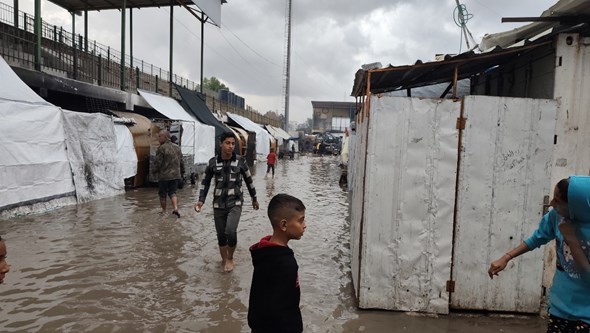
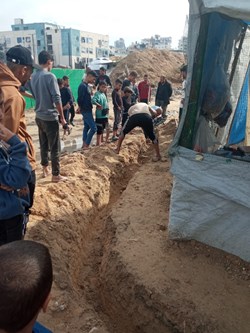
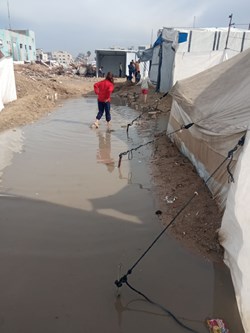
Return movements are increasing, exposing major gaps in WASH, shelter, site infrastructure, and contamination risk mitigation. Recent storms and flooding re-affirm that basic services remain absent
Humanitarian access is still inconsistent. Restrictions on staff entry, fuel, construction materials and imports continue to delay scale-up of lifesaving and basic needs assistance including Mine Action, Shelter & WASH.
DRC activities:
Access to water: Using site management as an entry point, DRC prioritises underserved sites with little or no water and sanitation. In our locations, an estimated 40–60% of households still receive less than 6 litres of drinking water per person per day and rely on trucking.
Sanitation and winterisation linkages: DRC considers priority need for emergency latrines (including for people with disabilities), desludging and solid-waste removal. Winterisation planning site-management led prioritisation, drainage improvements and basic vector control in flood-prone areas of Gaza City, Middle Area and Rafah.
Local WASH / EcRec solutions: DRC is exploring commercial imports and collaboration with local partners (e.g. local soap production) to address hygiene-kit gaps, in sites where soap access is lowest and skin diseases and diarrhea are widespread.
← →
Do not look at us as numbers on the news. We are human beings… we lived, we dreamed, and we loved. Help us preserve what remains of our humanity.
/ Abu Wassim's message to the world
Healthcare barely exists. His youngest son developed a chest infection, but they could not find antibiotics—only herbs. Shared latrines serve dozens of families, depriving people of basic hygiene and privacy. The war took away the family’s income along with his carpentry tools. They now rely on the little aid they can access, and on any job his son can find—carrying water or clearing the streets. Meals have been reduced to twice a day — sometimes less.
Now the fear is winter. The tent cannot withstand rain. Water pours through until clothes and blankets are soaked. One night, strong winds collapsed the tent, forcing the family into the open cold. Hiba, his daughter, developed a fever. They burn cardboard and rubbish just to survive the night.
What he needs most is simple: proper shelter, blankets, waterproof covers — not only for himself, but for all the displaced families around him. Yet, due to strict limitations on the entry of aid, even these essential items are impossible to find.
Hope comes from family. Their laughter means survival. He dreams of returning to Jabalia, reopening his carpentry workshop, sending children to school again.
* Names have been changed to protect the identity of those interviewed