Meet Mahmoud*: the trainer who lost his gym but kept his strength
Posted on 15 Jan 2026
Before the War: A Life of Stability and Strength
Before everything changed, Mahmoud lived in Rafah. He describes a life that was simple, active, and full of purpose. As both a nurse in Gaza’s health sector and a fitness trainer, his days were structured around caring for others, in the clinic and in the gym.
Before the conflict, Mahmoud’s strength was physical. Today, it is emotional; the strength to protect his family, survive displacement, and remain a source of support for others.
Seven Displacements, No Safe Destination
When danger came close to Rafah, Mahmoud, his wife, and their infant son faced the first of many escapes. They fled on 28 May 2024, not knowing that displacement would repeat itself another six times. Mahmoud describes the experience as one without safety and without certainty.
“I’ve been displaced seven times. Every time I thought it was the last, but there’s no end to this road. Even the prison didn’t protect me from the war. I lived in a prison, and every night I heard the bombing and said to myself: if even prison isn’t safe, where is safety?”
By September 2025, new displacement orders forced him to flee again. Holding his young son, he walked for three days through overcrowded areas where no shelters remained.
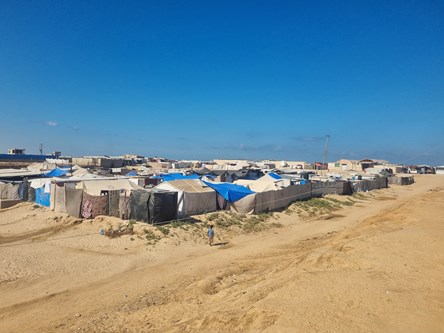
“There was no space anywhere. The only place left was Mawasi Rafah — it was a red zone, but I had no other choice.”
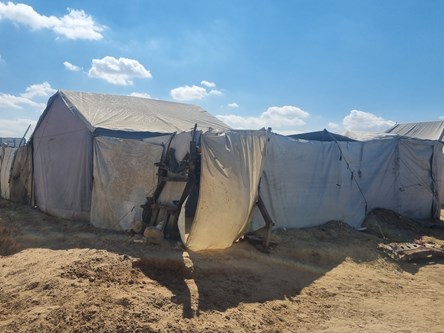
Today, the family lives in a small tent. His son learned to walk there — in a world he has never known without war.
“He opened his eyes to a world he never saw peace in,” Mahmoud said.“He learned to fear before he learned to speak.”
← →
Recent DRC winterization and hygiene support in Al-Mawasi (Rafah)
In October 2025, DRC and Palestinian Housing Council (PHC), in coordination with ICRC, delivered 1,225 hygiene kits to newly accessible sites in Al-Mawasi (Rafah)—the first humanitarian assistance since gaining access earlier in the month.
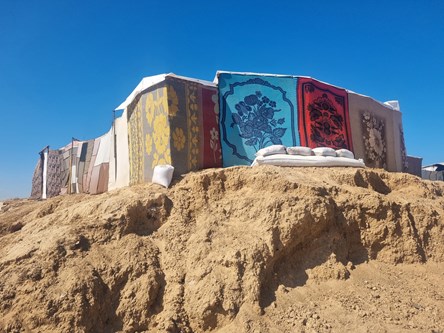
DRC partners reinforced six sites in southern Al-Mawasi (Rafah) with sandbags and slope protection to reduce flooding risks. In parallel, through the Agricultural Development Association (PARC), 5,000 tarpaulins were distributed and safely installed, strengthening shelter protection against rain and wind.
Daily survival: Water, food, and fear
Mahmoud explains how displacement has touched every element of life; how survival is no longer passive but a constant process of searching, rationing, and risk-taking. “Nights are full of fear, and days are full of worry, but we try to live.” The tent has no electricity. No running water. No protection from wind or heat. “When my son needs a bath, I take him to the sea beside the tent, and the boats start shooting. Even water has become dangerous.”
On many days, there was no food. “Sometimes I risked my life to reach GHF points just to find milk for my son. I couldn’t let him sleep hungry. I saw people dying in front of my eyes, I ran and faced death more than once just to bring back a piece of bread.” Before the war, Mahmoud weighed 90 kilos. Now he weighs 70. “I lost my body and muscles, but not my faith.. I still have a white heart.”
Despite exhaustion, he refuses to stand by while others suffer. He keeps a first-aid bag in his tent and treats people when he can — the nurse in him never left. “I’m a nurse. I can’t watch people suffer without helping. I always keep my first aid bag close, it’s my way to serve, even here.” He also volunteers with community kitchens, sharing what little exists. “We help each other here. The committees cook and share food. We survive because we stand together.”
Winter: The season he fears most
“Winter scares me more than the bombing. When the rain enters the tent, I feel like I’m drowning.” Rain collapses shelters. Blankets are not enough. Children get sick. Parents stay awake all night holding fabric down with rope. “There’s no heating, no enough blankets, but there’s a child who must stay warm. I try to cover him with my body. At night, the wind tears the tent, and I stay awake tying the ropes so it won’t fly away.
Last winter was hard, but the this one will be worse. The tent can’t handle one more drop of rain.” His request is simple — not safety, not certainty, just survival. “I just need something to keep my son warm and dry, blankets, and a roof that doesn’t leak.”
Maybe the war took everything, but it couldn’t take our will to live. We are not numbers. We are people who dream, love, and want to live. Please don’t forget us.
/ Mahmoud
What keeps him standing
Mahmoud has lost a career, a home, and a life he built over years, but he still wakes every day to keep his son alive. His hope is rooted not in what remains, but in who remains. “Every morning, I tell myself: I must stay standing for my son. I’m tired, but I’m still breathing the air of Rafah, and that air reminds me I still have a home.”
Like many fathers in Gaza, his dreams are small, human, and universal: “I don’t need much. I just want my son to have a normal childhood, one without fear.”
* Names have been changed to protect the identity of those interviewed