
12 Feb 2026
Ukraine: Heating assistance is critically important this win…
Despite ongoing hostilities in Ukraine, many people refuse to leave their homes until the very last moment. Only when explosions destroy their houses are they forced to make the painful decision to evacuate.

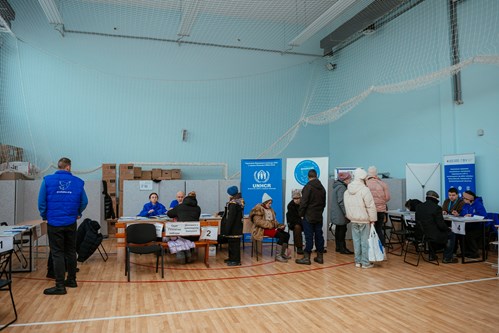
The large sports hall of the gymnasium in Voloske, Dnipropetrovsk Oblast — once filled with schoolchildren playing games — has now been converted into a reception of a transit centre for evacuees. The school itself is not operating because the building lacks a bomb shelter, a mandatory requirement for educational institutions during the war, which will mark its fourth anniversary on 24 February.
This centre reopened in 2025 for the third time. It also operated in 2014–2015 at the beginning of the conflict and again in 2022 at the start of the full-scale invasion. Since August 2025, more than 9,000 people have passed through it — either evacuating independently or with the help of volunteers and civil society organisations.
Inside the sports hall, directly on the basketball court, representatives of more than 40 organisations are ready to help. They provide legal, psychological, and protection assistance. Visitors can receive hygiene kits, basic necessities and food. Doctors and a medical team also provide free medication.
“If a person does not have a phone, we provide one so they can communicate afterwards. A mobile Administrative Services Centre visits us, and if someone needs to obtain an IDP certificate or consultation, they can do so on the spot,” explains Alina, Transit Centre Administrator at the CF Pomogaem, which manages the centre.
People arrive with very different needs. Some have somewhere to go and leave after receiving assistance. Others have already found accommodation nearby and come only for humanitarian aid. There are also those who cannot continue their journey until they resolve urgent problems — or simply have nowhere to go.

If people have nowhere to stay, we help them find accommodation. We look for shelter in the Volyn, Lviv, Poltava and Kirovohrad oblasts.
/ Alina, Transit Centre Administrator
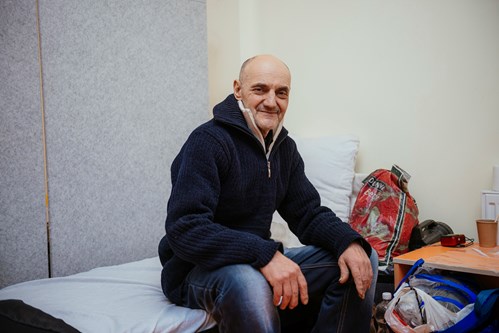
Maria, 82, is temporarily staying at the centre. Her house in the village of Novoandriivka burned down after shelling, and she now needs to restore her documents and bank card.
“My house in Prosiane village burned down. I moved to my parents’ home 12 kilometres away. It was snowing and I was clearing the yard. Then it struck… I did not hide because it kept flying constantly. Then I smelled smoke.
When I looked, the hall was already on fire — the roof burning, thick black smoke everywhere. Everything burned down — money and documents. It’s a miracle I survived. If it had happened at night, I would have died.”
Confused and unsure what to do, Maria was offered evacuation by nearby volunteers. Without documents, she hesitated, but fortunately, the village council had a copy of her passport.
“At a checkpoint, I was afraid they wouldn’t let me through and would leave me in the field. We arrived at the centre in the evening — they fed us and gave us a place to stay. By the end of the week, six relatives arrived, including a small child.”
While staying at the centre, she receives medical care, food and essential supplies. Once her documents and bank card are restored, Maria plans to travel to Kyiv, where her daughter-in-law lives.

Maria stays at the centre as a temporary haven until she figures out the issues with the documents and bank card. ©DRC Ukraine, Dnipropetrovsk Oblast, 2026, Krystyna Pashkina.
DRC Protection monitoring shows that in Dnipropetrovsk Oblast, displacement has intensified due to expanding hostilities and increased use of FPV drones and aerial strikes. Most displacement is self-initiated and reactive — people leave because staying is no longer feasible, rather than through organised evacuation.
According to the Protection Cluster, displaced people in the region include a high proportion of elderly residents: those aged 60+ account for approximately 34–45%, alongside many women and persons with reduced mobility. Movement is largely within the same oblast, indicating limited options and reliance on areas perceived as relatively safer rather than durable long-term solutions.
A major shift occurred on 2 December 2025 when mandatory evacuation was introduced for the first time in parts of the oblast, covering Novopavlivska, Velykomykhailivska and Mezhivska hromadas in Synelnykivskyi district — a sign of escalating danger.
Across all monitored regions, forced displacement is primarily driven by security threats: shelling, attacks on civilians, and destruction of housing.
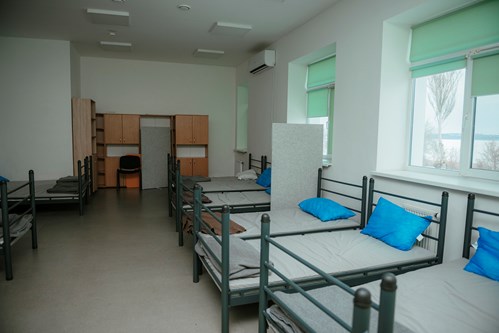
Over 100 people pass through the transit centre in Voloske each day. More than 30 currently live there, though it can accommodate over 140.
“Our youngest resident is three days old. The family has a separate room — they were evacuated directly from the maternity hospital. Tomorrow our family doctor will examine the baby,” says Alina.
Frequent winter power outages make self-sufficiency essential. The centre, therefore, has its own boiler room and generator.
The Danish Refugee Council funded staff salaries for three months in 2025 with support from the Swedish International Development Cooperation Agency and continues support through a further three-month project in 2026, funded through means donated by private foundations and individuals primarily in Denmark.
“Previously, we covered only salaries; now we can also finance household goods and other essentials needed for the centre’s operation,” explains Ihor, a DRC Partnership Officer.

Alina, the Transit Centre Administrator, discusses further support with Ihor, DRC Partnership Officer, in the centre’s reception space. ©DRC Ukraine, Dnipropetrovsk Oblast, 2026, Krystyna Pashkina.
For Oleh, 56, the centre became a critical stop on his journey.
“We were taken from Havrylivka by two Ukrainian soldiers — civilians aren’t allowed there anymore. One shot down drones while the other helped with our belongings. I had only seen such war on television before — now I’ve lived through it.”
Because of what he has been through, Oleh often bursts into tears. He admits that the stress of living under bombardment for many months had a tremendous effect on him.
“They said if we didn’t make it in time, we could die — it’s hard to imagine such a situation.”
His village has been devastated by rockets.
“Our house was torn apart — the left side gone. My father is 83, very weak, barely walking. They carried him out in their arms. Soon we leave for Kyiv — my brother has bought the tickets.”
After two days at the centre, his documents were processed, he applied for state financial assistance and received a bank card.
“Now I’m travelling knowing I have money and all my papers. Tomorrow we board the train — my brother will meet us there.”
The stories of Oleh and Maria illustrate the immense trials faced by civilians fleeing fighting in Ukraine. People rarely imagine abandoning everything they own — but when rockets destroy their homes, there is often no alternative but to seek safety elsewhere.
On that path, centres like the one in Voloske — offering comprehensive support — become either a bridge to a new beginning or a temporary refuge when nowhere else remains.
Oleh (on the left) couldn't believe his luck — he got to the centre unharmed despite the attack drone which pursued them. ©DRC Ukraine, Dnipropetrovsk Oblast, 2026, Krystyna Pashkina.



In February 2026, the war in Ukraine enters its fifth year. For communities along the front line and near the northern border, daily life remains defined by shelling, drone attacks and constant insecurity.
As the conflict evolves, humanitarian needs have deepened rather than diminished. Intensified long-range strikes and systematic attacks on energy, water and other essential infrastructure continue to disrupt basic services and put civilians at heightened risk.
Front-line towns are being emptied, while people living under occupation face grave violations of their rights.
An estimated 10.8 million people across Ukraine need humanitarian assistance. DRC remains committed to supporting those most affected by the war, focusing on communities facing the most severe conditions and ensuring continued access to protection, shelter and life-saving assistance. As humanitarian needs persist, DRC continues to deliver principled, needs-based support alongside national and local partners.