
02 Jan 2026
53 International NGOs warn Israel’s recent registration meas…
The village of Shevchenkove lies just 30 kilometres from Kupiansk in Kharkiv Oblast, an area currently witnessing heavy fighting. In April, the village itself came under shelling, causing significant damage. The Danish Refugee Council (DRC) is now helping to rebuild the affected homes.

Shevchenkove is a typical settlement situated close to the front line. Travelling here from the regional centre, Kharkiv, means passing several checkpoints. Nets stretch for metres over the roadways — a safeguard against combat drones.
The presence of military personnel is noticeable, unsurprising in a region that has endured four years of war and ongoing intense clashes. Yet daily life persists alongside the military: children ride their bicycles, someone repairs a car, others hurry to work. Many residents have remained in their homes and require support as they face the immense challenges brought on by the conflict.
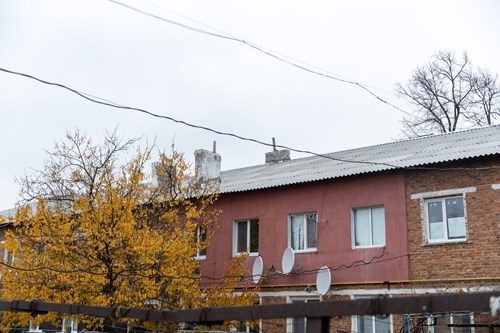
In April 2025, shelling left the apartment block where Valentyna and Liudmyla live severely damaged.
“I was at home when a rocket landed nearby. The windows were blown out, and the frame fell on me. At the hospital, they thought someone had beaten me. I also suffered a stroke because of it,” recalls 63-year-old Liudmyla, who is retired.
Despite everything, she has no intention of leaving her native village.
“We will stay till the end. Home is home. And there is nowhere else to go,” she says.
The blast also twisted and damaged her front door. For a long time, she was unable to close it, so she tied it to the wall with a piece of cloth.
Her neighbour, Valentyna, 53, was at work when the explosion occurred. She is a nurse at the local hospital and, together with her husband and two sons, plans to remain in Shevchenkove.
“The roof was badly damaged, and water leaked into the flat. Without help with the repairs, we couldn’t do it on our own. We would simply have had to live with all the damages,” she says.
The local authorities covered the roof with tarpaulin film, but this was a temporary fix. Also, the state programme provides replacement windows only for flats that are privatised and have the necessary documents.
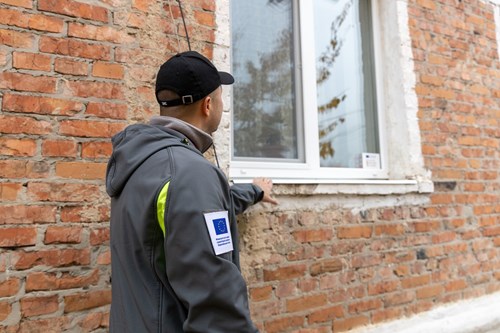
Thanks to a project funded by Switzerland through the Swiss Agency for Development and Cooperation (SDC), the DRC has fully restored the building’s roof, as well as the windows and doors in the common spaces. Funding from the European Union has enabled the installation of new windows in flats whose owners were unable to apply for state assistance.

“We were able to complete the work before autumn, so residents did not have to suffer from flooding or the cold.”
/ Ievgen Babaiev, Shelter and Settlement Manager
New windows, doors and a roof — renovations of the apartment building damaged by the blast wave. ©DRC Ukraine, 2025, Kharkiv Oblast, Olena Vysokolian



A warm, dry home is something many of us take for granted. Yet for countless people in Ukraine, this has become unattainable after years of relentless shelling.
Across many regions, the destruction of homes remains one of the most painful consequences of the war. This is not only a material loss but also a complex legal and humanitarian challenge. Destroyed documents, bureaucratic hurdles and limited resources all slow the path to recovery.
Although the state’s e-Vidnovlennia programme is gradually expanding access to compensation, the reality on the ground is far more complicated. In parts of Kharkiv and Donetsk oblasts, families have lost everything — their homes, belongings and personal archives — making it nearly impossible to prove property ownership. Adding to the burden are mined roads, a shortage of contractors, and the difficulty older people or those without digital access face in navigating online procedures.
As a result, many eligible individuals do not apply for assistance, heightening the risk of displacement or homelessness. In some communities in Donetsk Oblast, another challenge has emerged: people moving into abandoned houses out of desperation. This creates conflict when owners return or attempt to sell their properties.
Ukraine continues to improve its support systems, but the journey towards full housing recovery remains long and uncertain, particularly for those hardest hit by the war.
With support from the SDC, the DRC will help to repair homes for more than 500 households across Kharkiv, Sumy, Chernihiv, Dnipropetrovsk, Zaporizhzhia and Donetsk oblasts. The assistance prioritises the most vulnerable, including internally displaced persons (IDPs), women-headed households, older people and persons with disabilities.
EU funding will enable minor and medium repairs for over 400 additional households. Moreover, DRC lawyers support those eligible for the state compensation mechanism with document preparation and the application process.
For residents of Shevchenkove, this humanitarian assistance is more than material support — it is a reminder that they are not forgotten.
“We are very lucky to have you. Your support means a lot to us,” says Liudmyla with a warm, sincere smile.
Step by step, humanitarian organisations are helping affected communities rebuild their homes — the essential foundation for rebuilding their lives.
